


First ever:
Laminaria pallida dropper
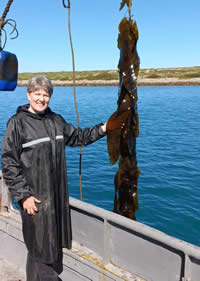
Macrocystis pyrifera dropper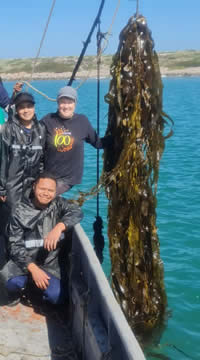
Advisory & Consulting Services:
Dr Lizeth Botes obtained her BSc at the University of Port Elizabeth in 1994, her BSc Honours in 1996 at the University of Stellenbosch and her PhD in 2003 at the University of Cape Town (specializing in Aquaculture). In 2004, she was contracted in by the Provincial Government of the Western Cape to start a Coordinating Agency for the Aquaculture Sector called the Aquaculture Institute of South Africa (AISA). From 2004 – 2010, she worked for AISA as the CEO and initiated and coordinated (in collaboration with various organisations) much needed programmes and projects for the Aquaculture Sector. These collaborations included both international and national organisations such Swisscontact , Marine Institute in Ireland, Bureau Veritas Group in Denmark, World Wide Fund (WWF), Industry Associations, Industry Working Groups, Universities, Colleges, Government, Conservation agencies, Animal Welfare agencies and many more. She served from 2006-2010 as the Chairperson of the Southern Aquaculture Working Group (SAWG) and from 2006 – 2010 as an Executive Member on the Aquaculture Association of Southern Africa’s (AASA) Executive Committee . From 2011 onwards and with nearly 30 years of experience in the South African Aquaculture Sector, Dr Botes continues to work in the industry by providing advice to new and already existing aquaculture businesses.
Present and past projects/programmes include:
2011- to date: Aquaculture projects and programmes
1. Project Manager of the South African Kelp Farming Project (SA KFP):
The project was funded by UK Internaional Development via the Foreign, Commonweallth & Develoment Office (FCDO), implemented by the Bibalve Shellfish Farmers' Associaiton of South Africa (BSASA) and supported by the Department of Forestry, Fisheries and Environment (DFFE). The Phase 2 Feasibility study (implemented from 2022-2025) carried out the first successful full life cycle cultivation of the three local kelp species (Ecklonia maxima, Laminaria pallida and Macrocystis pyrifera) in an aquaculture setting in Africa.
- For more information on the project visit https://www.phycologysa.co.za/kelp-farming-project
- Watch the promotional video here https://youtube.com/@southafricankelpfarmingproject
- For a copy of the Final Project Report (containing the Hatchery & Nursery Report, Weaning & Grow-out Report and the Food Safety and Nutritional Value Report), click here SA KFP Phase 2 Feasibility Study - Final Project Report
- For the basic Standard Operating Prodecures (SOPs) and training videos, click here SA KFP- Kelp farming SOPs
2. Abalone farm Standard Operating Procedures (SOP's): Writing, Training and Implementation thereof
3. Assisting the AgriSETA with the development of Aquaculture Qualifications (Aquaculture Farmer and Aquaculture Farmworker) to be implemented in the new QCTO National Qualifications Training Framework.
4. Assisting abalone farms with their Red Tide Management Plans
5. Assisting abalone farms with submitting their Workplace Skills Plans (WSP) and Annual Training Reports (ATR)
7. Assisting and advising abalone farms on their workforce training needs
8. Assisting the Swiss Import Promotion Programme (SIPPO) with sourcing South African Aqauculture companies to attend the Brussels Seafood Expo in 2013.
2004 - 2010: Aquaculture projects and programmes
1. In 2010, assisting the WWF with incorporating Aquaculture species into their Southern African Sustainable Seafood Initiative (SASSI) pocket guide.
2. In 2009-2010, in collaboration with WWF-SA, compiling a Practical Guide to Responsible Aquaculture.
3. In 2009, putting in place the first visual representation of the Western Cape aquaculture sector in the form of a GIS map in collaboration with the Western Cape provincial government.

4. 2009 AISA Benchmarking Survey (including the supply and demand side) of the South African Aqauculture sector.
5. 2006 AISA Benchmarking Survey of the South African Aquaculture sector
6. Initiating and coordinating the Trout Quality and Health Management Programme (QHMP) from 2008-2011.
7. In 2010, facilitating and coordinating a friendly EU assessment of the Trout QHMP in 2010 (in collaboration with Swisscontact [South Africa] and Bureau Veritas Group, [Denmark])
8. In 2004, facilitating and coordinating a "mock EU mission" to assess the South African Shellfish Monitoring Programme (SMP) (in collaboration with the Marine Institute, Ireland)
9. Initiating and coordinating the Skills Development and Training programme (STP) from 2008-2011.
10. In 2006, reported on 2 case studies of Transformation and Black Economic Empowerment in the Aquaculture sector
11. In 2006, investigating and reported on the value-adding opportunities, by-product opportunities and cross-sector opportunities in the aquaculture sector.
12. Assisting various government departments on provincial and national level with Aquaculture policies and strategies.
2001 – 2004: International Global Ballast Water Management Programme
1. Saldanha Bay Port Survey project: Phytoplankton identification catalogue
2. Brown tide project: The Brown tide species, A. anophagefferens has a negative impact on the marine aquaculture industry situated in Saldanha Bay. This project investigated (in collaboration with the CSIR) the social-economic impact of this species in the area, shipping routes between the USA and RSA, the genetic relatedness of the USA and RSA species and aims to conclude if the possibility exist of it being introduced from the USA
3. Ballast Water Treatment project. This project (in collaboration with Resource Engineering Environmental Solutions) investigated ballast water treatment options for ships entering South African waters and harbours